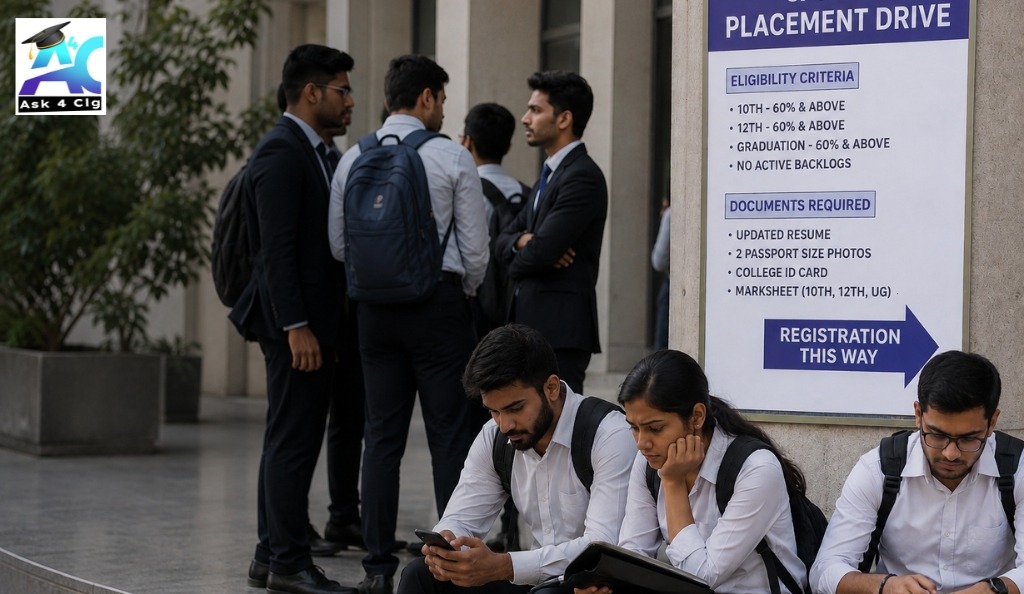
Every year, lakhs of students in India choose colleges based on one sentence: 100% placement guarantee!
That single promise influences lakhs of career decisions, education loans, relocation, and sometimes even family expectations. Parents proudly discuss average packages. Coaching institutes advertise Full Placement Support.
But once admission season ends and the actual placement cycle begins, many students discover a very different reality.
While some never sit for the top companies that they were promised, others only realize that a handful of students received those dream packages. This gap between marketing and reality is exactly why students and parents need to understand how college placements in India actually work.
Ahead, we are going to share the reality of college placements in India and how to choose the right partner for the best placement in an organization that is only meant for you.
Why College Placements in India Are Becoming Complicated
Placement strategy was different a decade ago.
Students only needed to join a good college of engineering or management, study well enough, undergo campus recruiting, and get a respectable job.
But within the past years, things have undergone massive changes.
The companies no longer hire as they did before. The advent of AI is disrupting entry-level jobs. Even though startups hire according to skill set, not qualifications, big firms are being choosy about the colleges they frequently visit.
At the same time, there is an enormous rise in the number of colleges in the country.
Engineering colleges, management colleges, B-schools, private universities, and professional colleges all try to attract the same set of recruiters. As expected, not all colleges could perform well when it comes to placements.
Here, a lot of students fall into trouble.
They equate placement help with direct placements. These are two very different aspects altogether.
The Biggest Myth of 100% Placement
Probably one of the most deceiving terms used in the Indian higher education business would be 100% placement. This is due to the following reasons:
- Only eligible candidates were considered
- Off-campus jobs were counted
- Internship-to-job ratio was taken into consideration
- Sales-based low-salary jobs were included
- Students opting for higher studies were not counted
A college might have outstanding placement figures, but its placements could be pretty average.
This explains why students should not decide on colleges depending on figures such as the best package offered. A 25LPA job offer abroad seems amazing, but in reality, what should really matter is:
- Average salary offered
- Number of core companies recruiting
- Quality of the role offered
- Internship opportunities
- Career growth prospects
- How alumni performed after 3-5 years
Strangely enough, few students even consider these aspects at all during admissions, even in 2026.
MBA Placements: Expectations vs Reality
The admission market for MBAs in India has become highly competitive.
Both Tier-1 business schools and newer private management colleges emphasize leadership opportunities, corporate experiences, and attractive salaries. But MBAs are determined by factors such as specialization, networking skills, communication skills, and experience.
Two MBAs graduating from the same college can have vastly different career paths.
One could be employed as a consultant with an excellent offer. Another might find it difficult to get past interview stages other than that of a sales executive.
The reason is simple: adequate preparation and quality profile make all the difference.
And this is why students looking at MBA admission must look further than college brochures.
They must consider:
Industry Connections
Does the institute have consistent recruiter relationships or occasional placement drives?
Internship Ecosystem
Summer internships often decide final placement opportunities in MBA programs.
Alumni Network
Strong alumni presence matters more than many students realize. Alumni referrals quietly influence hiring across industries.
Skill Development
Does the curriculum actually improve communication, business understanding, analytics, and leadership skills?
Engineering Placements Are Facing a Major Shift
Engineering admissions continue to dominate India’s higher education landscape, but the hiring market has evolved rapidly.
Earlier, mass recruiters absorbed huge numbers of graduates annually. Now companies prioritize:
- Problem-solving ability
- Real projects
- Coding skills
- AI and automation exposure
- Communication skills
- Internship experience
It has resulted in a massive gap.
Students at the same institution face different experiences regarding placements based on how they spent their four years. Some students develop great portfolios and receive outstanding offers, and some still rely solely on learning in class and struggle during recruitment.
The bitter reality is...
A degree no longer guarantees anything.
The Hidden Placement Factors Most Students Ignore
This is where many college counselling conversations fail.
Students ask:
“What is the package?”
But they rarely ask:
“What environment will actually help me become employable?”
That second question matters more.
Here are some hidden factors that significantly affect placement outcomes.
Location Advantage
Colleges in proximity to corporate giants, like Bengaluru, Pune, Hyderabad, NCR, or Mumbai, have easier recruitment access.
Even mediocre colleges in good ecosystems sometimes do better than top-notch institutes in rural areas.
Peer Group Quality
Motivation, competition, mode of communication, and exposure depend upon your peer atmosphere. Those who have ambitious classmates are bound to make proper preparations for their placements.
Faculty Industry Exposure
Most educational institutes follow the approach of theoretical teaching. The institutes having faculty members aware of the latest industrial trends are more prepared.
Internship Culture
Some campuses actively push internships from the first or second year onward. Others barely support practical exposure. That difference becomes very visible during final placements.
Why Students Still Choose Colleges Emotionally
This happens every admission season. Most students see:
- A beautiful campus
- Attractive infrastructure
- Viral social media marketing
- One impressive salary figure
- Influencer promotions
And suddenly, the decision becomes emotional rather than strategic. Meanwhile, important questions get ignored:
- What is the average package for my specific course?
- Which companies recruit regularly?
- What roles are students actually getting?
- How many students remain unplaced?
- Are placements centralized or department-wise?
- Does the college support off-campus preparation?
This is exactly why proper admission counselling matters today more than ever. A good consultant doesn’t just help students secure admission. They help students avoid expensive career mistakes.
How Admission Consultants Can Build More Trust
The education consultancy sector is changing as well.
Today, students and their parents are more astute. They fact-check placement numbers, cross-check LinkedIn profiles of graduates, review feedback, and analyze ROI before joining an institute. This implies that the consultancies need to adapt to the times as well.
Rather than concentrating merely on admissions numbers, it will be beneficial for those consultants who provide accurate career guidance to create trust among themselves.
A reputable admission consultant will always help you understand:
- Salary potential
- Career compatibility
- Job market trends
- Relevance of course
- Placements
- Job prospects
- Skill requirements
- Trust leads to referral.
Final Thoughts
College placements in India are neither completely fake nor completely guaranteed.
They sit somewhere in between.
At Ask4clg, we promise to improve opportunities, exposure, networking, and recruiter access. We explain the realities honestly and genuinely guide you throughout the admission process to help you get placement in the most deserving position.
That difference matters more than ever in today’s education landscape. So, get in touch with our expert counsellors and choose the best confidently!
Related Posts

Sam College of Engineering and Technology Admission 2024: Dates, Fees, Eligibility, Selection Criteria
The institute offers BE and Diploma programs in Engineering at the undergraduate level for a duration of 4 years and 3 years respectively. The intake for BE and Diploma programs is 60 seats per course, with the only exception being Mechanical Engineering which admits 120 students per year.SAM College of Engineering and Technology (SAMCET) is a reputed college of the SAM Group. It is located in the state of Madhya Pradesh. It provides various professional courses like BE, Diploma, M.Tech, MCA, and MBA.Direct Link to Apply for SAMCET Admission Admission to BE is conducted on the basis of the results of the Pre-engineering test
Read More
SSN College of Engineering (SSNCE) Admission 2024: Eligibility, Selection Criteria, Admission Process
SSN College of Engineering (SSNCE), established in 1996, is an engineering college located in Chennai, Tamil Nadu. It is affiliated to Anna University. SSNCE is the one engineering college under the USN chain of institutions. SSN College of Engineering offers B.Tech and M.Tech programs in full-time mode. Candidates seeking admission will have to fill the online application form available at the official website of the institute. The application fee is INR 1250/- for all the programs. Admission to both programs are done based on merit of the qualifying examination. The admission test scores decide whether the candidate receives the scholarship or not.
Read More
Sagar Institute of Science and Technology (SISTEC), Bhopal Admission 2024: B.Tech, M.Tech, MBA
Sagar Institute of Science and Technology (SISTec) is a premier engineering and management institute located in Bhopal, Madhya Pradesh. It was established in the year 2001 and it is affiliated to Rajiv Gandhi Proudoyogiki Vishwavidyalya (RGPV).Sagar Institute of Science and Technology offers B.Tech, M.Tech and MBA program in various specializations. Both online and offline mode of application is acceptable for M. Tech, MBA courses.Candidates securing a minimum of 45% in PCM/B at 10+2 level are eligible to apply for B. Tech and B. Pharm programs.Candidates with minimum aggregate marks of 45% in the relevant/any discipline at graduation level are eligible to apply
Read More
SCET Admission 2024: Cut Off, Fees, Entrance Exam
Sahrdaya College of Engineering and Technology is a private college affiliated with Calicut University that was established in 2002. Located in Thrissur, it is an ISO 9001:2015 certified college with a ‘B’ accreditation from NAAC and an ‘SIRO’ grading from DSIR.SCET has a distinguished faculty. There are 80 faculty members; out of them, 42 have a PhD. The institute offers state-of-the-art infrastructure. SCET offers four courses: B.Tech, B.Tech (lateral), M.Tech, and PhD. There are six specializations under the B.Tech course. To qualify for B.Tech, a candidate needs to have passed 10+2 with PCM. For selection, they need to take the KEAM
Read More
Sai Vidya Institute of Technology Admission 2024: Cut Off, Fees, Application Form, Eligibility
Sai Vidya Institute of Technology (SVIT) is a reputed educational institution imparting quality education in the fields of Engineering and Management. It was established in 2008 by Sri Sai Vidya Vikas Shikshana Samithi. The institute is affiliated with Visvesvarya Technological University (VTU), Belagavi. It is located in Bangalore, Karnataka.Sai Vidya Institute of Technology offers various UG and PG degree courses in the field of engineering along with an MBA program with 3 management disciplines. All courses offered by the institute are approved by AICTE, New Delhi and recognized by UGC.Engineering Diploma holders with 45% minimum marks may seek admission to B.E. 3rd semester
Read More