BBA or Bachelor of Business Administration, is a great start for students who want to build a career in business, management, and entrepreneurship.
Even though this is a graduation course chosen after 12th, the exam usually doesn’t test one subject in isolation. A simple paper can move from English vocabulary to a percentage problem and then jump to a logical reasoning puzzle.
Wondering what type of questions to prepare for before appearing in the BBA entrance exam? Let’s break down the types of questions to prepare for.
What Does a BBA Entrance Exam Test?
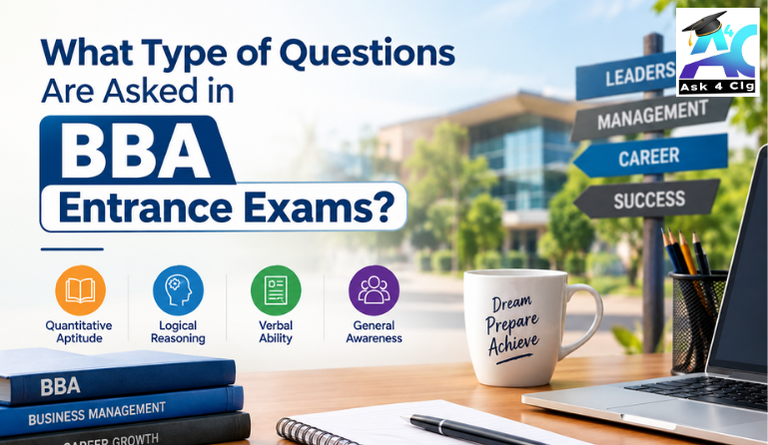
Most BBA entrance exams assess a combination of English language skills, quantitative aptitude, logical reasoning and general awareness. The exact sections, difficulty and marking scheme may vary from one university or entrance test to another.
Some exams may give greater weight to aptitude, while others include current affairs, business awareness or additional sections.
Major exams like IPMAT, SET, and CUET evaluate these specific competency pillars:
- Quantitative aptitude & numerical ability
- Logical & analytical reasoning
- English language & comprehension
- General & business awareness
- Management aptitude
BBA Entrance Exam Question Pattern: What to Expect
Though the exact pattern differs by exam, questions generally fall into these broad categories:
| Section | Common Question Types |
| English | Grammar, vocabulary, reading comprehension, sentence correction |
| Quantitative Aptitude | Percentages, ratios, averages, profit & loss, arithmetic |
| Reasoning | Series, coding-decoding, arrangements, analogies, logical puzzles |
| General Awareness | Current affairs, business, economy, general knowledge |
The difficulty of the BBA entrance exam is generally designed around school-level fundamentals rather than advanced mathematics or specialised management concepts.
1. BBA Entrance Exam English Questions
Students often assume the English section is a simple vocabulary test.
But depending on the examination, you may encounter questions on grammar, vocabulary, sentence structure, reading comprehension, synonyms and antonyms, and fill-in-the-blanks.
Common English Question Examples
For example, you might be asked to identify the grammatically correct sentence:
- Neither of the boys have completed their assignment.
- Neither of the boys has completed his assignment.
The concept is basic subject-verb agreement. The real test is whether you can identify the error quickly within the given time or not.
2. BBA Entrance Exam Quantitative Aptitude Questions
Even the discussion of this section often makes students nervous. Especially those who are not comfortable with mathematics.
But there is good news for BBA aspirants. BBA entrance exams generally focus more on basic mathematical concepts and their application to complicated calculations.
The questions may involve:
- Percentages
- Ratio and proportion
- Average
- Profit and loss
- Simple and compound interest
- Time, speed and distance
- Time and work
- Number systems
- Data interpretation
- Basic algebra
3. BBA Entrance Exam Reasoning Questions
Reasoning questions test how comfortably you can identify patterns, relationships and logical connections.
Typical areas include number and alphabet series, analogies, coding-decoding, blood relations, directions, syllogisms, classification and seating arrangements.
However, prepare for complex questions as well. For instance, you could be given a sequence such as: 2, 6, 12, 20, 30, ?
This is why reasoning preparation should focus on pattern recognition, not memorising solutions.
BBA Entrance Exam Syllabus 2026
Unlike school board exams, the BBA entrance exam does not follow a strict syllabus as this is a very job-oriented course. A better approach is to divide preparation into three stages.
Stage 1: Build the Fundamentals
Start with the concepts you repeatedly encounter in aptitude, English and reasoning. Don't rush into difficult mock papers before your basics are reasonably strong.
Stage 2: Practise Question Types
Once the fundamentals are clear, solve questions topic by topic. This helps you recognise recurring patterns and identify your weak areas.
Stage 3: Shift to Timed Practice
This is where preparation starts resembling the actual exam.
Take sectional tests first and then complete mock papers under realistic time limits. Review every wrong answer rather than simply checking your score.
Best Books for BBA Entrance Exam Preparation
Though there is no single best book for every BBA aspirant, you can check out these subject-wise books for better preparation:
Quantitative Aptitude / Numerical Ability:
- Quantitative Aptitude for Competitive Examinations by R.S. Aggarwal (best for foundational concepts).
- Fast Track Objective Arithmetic by Rajesh Verma (best for shortcut methods and speed).
Logical Reasoning & Analytical Ability:
- A Modern Approach to Verbal & Non-Verbal Reasoning by R.S. Aggarwal.
- by M.K. Pandey (best for advanced logical puzzles).
Verbal Ability & English Language:
- Word Power Made Easy by Norman Lewis (essential for vocabulary).
- Objective General English by S.P. Bakshi.
- High School English Grammar & Composition by Wren & Martin.
General Knowledge & Current Affairs:
- Manorama Yearbook (for static GK and annual updates).
- Read national newspapers daily, like The Hindu or business dailies.
Some universities publish an official syllabus or sample paper. Check if your target business universities offer an official syllabus or any preparation guide.
FInal Thoughts
Knowing what questions are asked in a BBA entrance exam is only the first step. The bigger advantage comes from understanding your target exam, identifying your weak areas and practising with a clear strategy instead of studying everything at random.
If you are planning to pursue BBA and need guidance on entrance exams, preparation or choosing the right course and college, get in touch with Ask4clg’s admission experts for personalised guidance.
Frequently Asked Questions (FAQs)
Is there a fixed syllabus for all BBA entrance exams in India?
False. There isn't one syllabus common to all BBA entrance examinations. CUET-UG, IPMAT, JIPMAT, and the entrance examination of individual universities may differ in the areas covered, subjects included, and eligibility criteria.
Which subjects are most important for BBA entrance exams?
English, quantitative aptitude and logical reasoning are some of the most popular sections. Certain competitive exams may also include general knowledge or specialized subjects. For instance, IPM AT 2026 conducted by IIM Rohtak consists of quantitative ability, logical reasoning and verbal ability.
Are BBA entrance questions easy or difficult compared to JEE/NEET?
BBA entrance tests differ from JEE/NEET by the fact that they test an entirely different set of skills. While the JEE/NEET tests are largely based on scientific subjects, the BBA entrance tests test aptitude and reasoning skills along with proficiency in English and other related skills.
Do BBA entrance exams have negative marking?
Yes for some, but no for others. For instance, negative marking is applicable to the MCQs in IIM Indore's IPM AT 2026 but not in the quantitative short answer section. The IIM Rohtak's IPM AT 2026 exam also uses the concept of negative marking.
Is Class 11–12 Maths required for BBA entrance preparation?
Not for all BBA entrance examinations. The requirements differ from examination to examination and programme to programme. Yet, quantitative aptitude often involves school-level mathematics. A good grounding in basic arithmetic and mathematics may prove useful.
Can I crack BBA entrance without coaching?
Yes. Coaching is not compulsory. With the proper curriculum, study material, last year's papers, test series and a study timetable, one can self-study.
Which BBA entrance exam is the easiest to qualify?
It can be said that there is no easy entrance examination to BBA because it depends on many factors like difficulty level, eligibility criteria, competition, and selection procedure. Rather than opting for an examination based only on the difficulty factor, compare the syllabus and criteria with your preparation level.
How many months are enough to prepare for BBA entrance exams?
3 to 6 months of preparation can be useful for most of the students as a period for preparation. It might be a longer period for students with weaker fundamentals, whereas it would be a shorter one for the talented and intelligent ones.
Are there any interview or GD rounds after the BBA written test?
The decision will be made based on the institute. Some institutes will have admission through just the entrance test, while some will have the Personal Interview process along with that. For instance, IIM Indore’s 2026 IPM admission process has both the Aptitude Test and Personal Interview process. The same goes for IIM Rohtak.
Which books or online resources are best for BBA entrance preparation?
Selecting books depends upon your entrance test. The priority must be your syllabus and past papers and then you can refer to some well-known books to prepare yourself in aptitude, reasoning and English language. The best way to begin for CUET-UG is the syllabus of NTA.
Related Posts

Sam College of Engineering and Technology Admission 2024: Dates, Fees, Eligibility, Selection Criteria
The institute offers BE and Diploma programs in Engineering at the undergraduate level for a duration of 4 years and 3 years respectively. The intake for BE and Diploma programs is 60 seats per course, with the only exception being Mechanical Engineering which admits 120 students per year.SAM College of Engineering and Technology (SAMCET) is a reputed college of the SAM Group. It is located in the state of Madhya Pradesh. It provides various professional courses like BE, Diploma, M.Tech, MCA, and MBA.Direct Link to Apply for SAMCET Admission Admission to BE is conducted on the basis of the results of the Pre-engineering test
Read More
SSN College of Engineering (SSNCE) Admission 2024: Eligibility, Selection Criteria, Admission Process
SSN College of Engineering (SSNCE), established in 1996, is an engineering college located in Chennai, Tamil Nadu. It is affiliated to Anna University. SSNCE is the one engineering college under the USN chain of institutions. SSN College of Engineering offers B.Tech and M.Tech programs in full-time mode. Candidates seeking admission will have to fill the online application form available at the official website of the institute. The application fee is INR 1250/- for all the programs. Admission to both programs are done based on merit of the qualifying examination. The admission test scores decide whether the candidate receives the scholarship or not.
Read More
Sagar Institute of Science and Technology (SISTEC), Bhopal Admission 2024: B.Tech, M.Tech, MBA
Sagar Institute of Science and Technology (SISTec) is a premier engineering and management institute located in Bhopal, Madhya Pradesh. It was established in the year 2001 and it is affiliated to Rajiv Gandhi Proudoyogiki Vishwavidyalya (RGPV).Sagar Institute of Science and Technology offers B.Tech, M.Tech and MBA program in various specializations. Both online and offline mode of application is acceptable for M. Tech, MBA courses.Candidates securing a minimum of 45% in PCM/B at 10+2 level are eligible to apply for B. Tech and B. Pharm programs.Candidates with minimum aggregate marks of 45% in the relevant/any discipline at graduation level are eligible to apply
Read More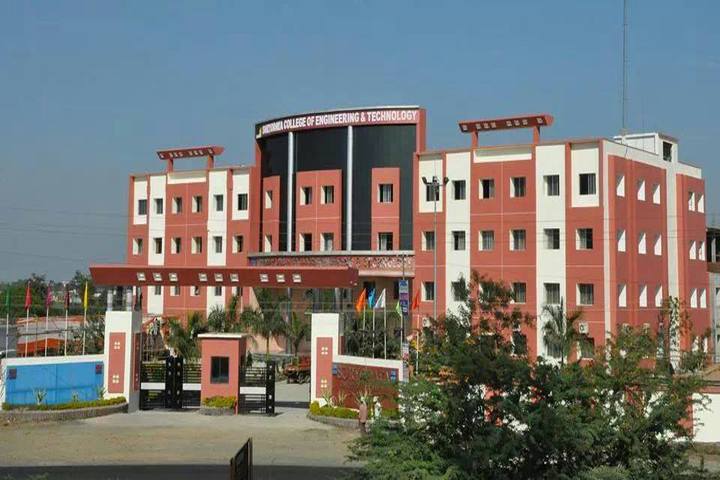
SCET Admission 2024: Cut Off, Fees, Entrance Exam
Sahrdaya College of Engineering and Technology is a private college affiliated with Calicut University that was established in 2002. Located in Thrissur, it is an ISO 9001:2015 certified college with a ‘B’ accreditation from NAAC and an ‘SIRO’ grading from DSIR.SCET has a distinguished faculty. There are 80 faculty members; out of them, 42 have a PhD. The institute offers state-of-the-art infrastructure. SCET offers four courses: B.Tech, B.Tech (lateral), M.Tech, and PhD. There are six specializations under the B.Tech course. To qualify for B.Tech, a candidate needs to have passed 10+2 with PCM. For selection, they need to take the KEAM
Read More
Sai Vidya Institute of Technology Admission 2024: Cut Off, Fees, Application Form, Eligibility
Sai Vidya Institute of Technology (SVIT) is a reputed educational institution imparting quality education in the fields of Engineering and Management. It was established in 2008 by Sri Sai Vidya Vikas Shikshana Samithi. The institute is affiliated with Visvesvarya Technological University (VTU), Belagavi. It is located in Bangalore, Karnataka.Sai Vidya Institute of Technology offers various UG and PG degree courses in the field of engineering along with an MBA program with 3 management disciplines. All courses offered by the institute are approved by AICTE, New Delhi and recognized by UGC.Engineering Diploma holders with 45% minimum marks may seek admission to B.E. 3rd semester
Read More